

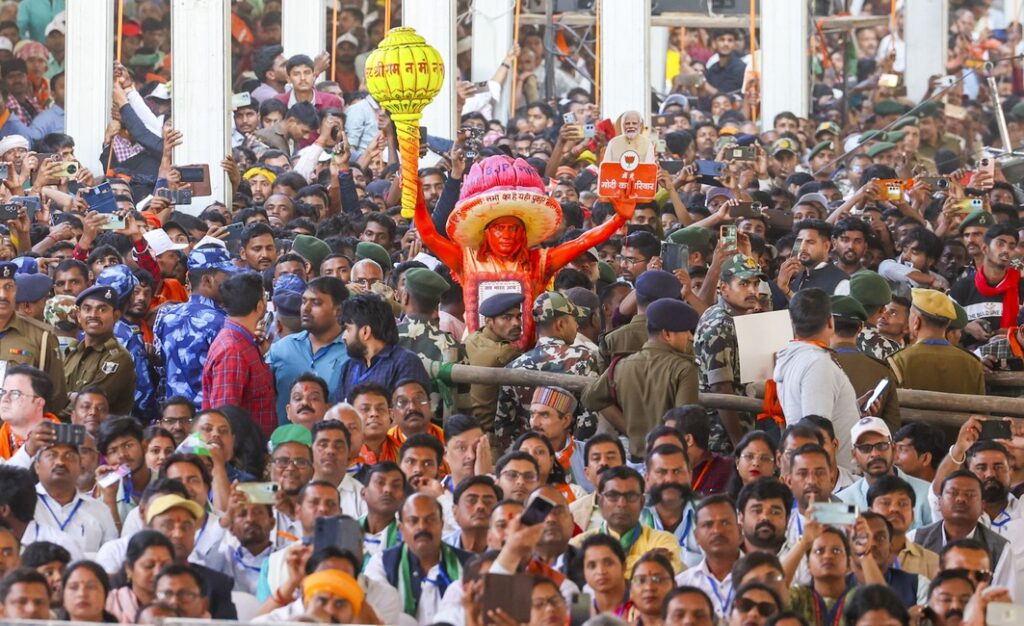
Since the ascent of the BJP to power in 2014, a major realignment of politics has taken place in India, making it difficult for smaller parties to remain relevant
Post-2014, there has been a significant political realignment, with national and state politics having gradually shifted to a bipolar system. The outcomes of the past few elections indicate this. How long this new alignment will last remains to be seen
Something is changing in Indian politics, which has not caught the attention of political observers: the shrinking of political space for a third front. If we analyse the election results of the past few years, a clear pattern seems to emerge. Either a party gets a bumper mandate or there is such a close contest that the third force is completely wiped out.
The latest example is the 2025 Delhi Assembly elections, where the contest was limited to the Bharatiya Janata Party (BJP) and the Aam Aadmi Party (AAP). Despite a better performance by the Congress—compared to the outcome in the past two elections—67 out of the 70 candidates fielded by the party lost their security deposits. This is the same party that was in power in Delhi for three consecutive terms. Similarly, the Bahujan Samaj Party (BSP), which once had a strong presence in the Delhi Municipal Corporation elections, contested in 68 seats and lost its deposits in all. More than 50 candidates of the once formidable BSP could not even touch the threshold of 1,000 votes. Its candidate in the Matia Mahal seat got only 130 votes. The situation is such that the BSP got only 0.58% of votes, while the BJP’s ally at the Centre, the JD (U), which contested only one seat, got 1.06% of votes.
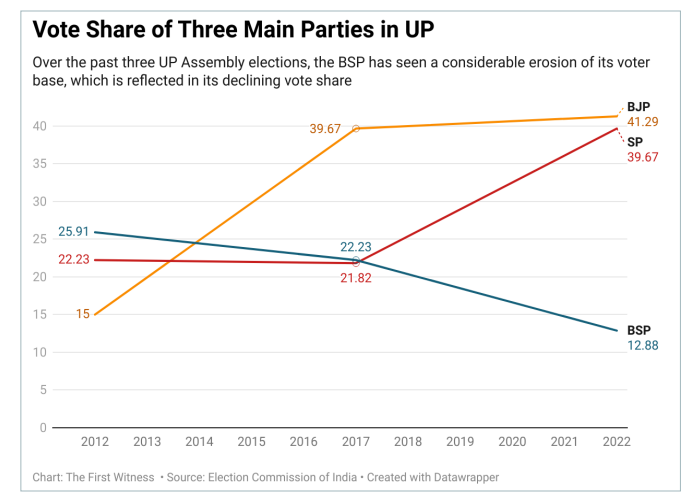
It’s not that the BSP suffered a setback only in Delhi in recent times. In Uttar Pradesh, where the BSP stormed to power in 2007 by garnering 30.43% of votes, which amounted to 206 seats in the Vidhan Sabha, it got just 9.39% of votes in the 2024 Lok Sabha elections. It’s clear that a new pattern is emerging where the space for a third political alternative is shrinking. In UP, the BSP, which has been relegated to third place in the Assembly, has lost a significant chunk of its voter base to the BJP and Samajwadi Party (SP).
In the 2024 Lok Sabha elections, in. West Bengal the All-India Trinamool Congress (AITMC) got 43.3% of votes, while the BJP got 40.3%. The Congress, on the other hand, got only 5.6% of the vote share and the Left Front was reduced to 6.3%. These figures, more or less, were a repeat of the 2021 West Bengal Assembly elections, when the TMC got 48.02% of votes and the BJP cornered 37.97% while the alliance of the Congress-Left Front and other parties was reduced to a mere 10.4%.
In Assam too, the contest has been limited to the BJP and the Congress, and the Asom Gana Parishad, which was once the strongest party in the state’s politics, is now the junior partner of the BJP. Haryana is now completely divided between the Congress and BJP. The parties of the sons and daughters of Bhajan Lal and Bansi Lal are finished, while the party of Devi Lal has disintegrated into multiple factions due to family feuding.
In Rajasthan, the Congress and the BJP are in a direct contest. The same is the case in Madhya Pradesh, Gujarat, Chhattisgarh, Uttarakhand, and Himachal Pradesh. There is hardly any state left where the fight is triangular. In Karnataka too, the political stature of the Janata Dal (Secular) is steadily eroding, while in Tamil Nadu the contest has been between the Dravida Munnetra Kazhagam (DMK) and the All-India Anna Dravida Munnetra Kazhagam (AIADMK) for decades.
Tamil Nadu politics is witnessing an interesting turn, but smaller parties have not been very successful in making their presence felt. Now the situation is such that small parties are forced to form alliances with big parties. Without such an arrangement, they are incapable of winning any seats, though they can spoil the chances of bigger parties in a few seats.
The survival of smaller political formations has been reduced to their ability to gauge political winds. If they are accurate, they can enjoy the benefits of power like Pallavi Patel (Apna Dal) or they can get reduced to political insignificance like Upendra Kushwaha (Rashtriya Lok Samata Party).
It is increasingly clear that state-level politics has been reduced to bipolar contests. If we look at national politics, despite the Congress failing to reach the one-third mark in the past three general elections, it remains the only alternative to the BJP at the national level. It is still the only party with a pan-India reach.
It’s often said that anything is possible in politics but, at the moment, the possibility of a third front does not seem to be a realistic option that can break up the bipolar set-up. Polarisation at the political level has now become so acute that the possibility of the Left parties and the BJP coming together as in the Janata Dal experiment of 1989 is negligible and the Left parties, the biggest proponents of the third front, have become electorally irrelevant.
Why is the third force, that is, the smaller parties, becoming irrelevant? According to Rajkumar Phalwaria, professor of political science at Delhi University, “The politics of smaller parties was not based on any ideological basis but on opportunism and bargaining. From 1989, the country saw a sustained period of political instability not only at the Centre but also in many states. There was a hung Lok Sabha at the Centre and hung Assemblies in the states.”
It is true that during this period V.P. Singh emerged like a colossus and then faded. P.V. Narasimha Rao ran a minority government for the full term of five years, but after that the tenures of H.D. DeveGowda and Inder Kumar Gujral were very brief. In Uttar Pradesh, between 1995 and 2002, Mayawati became chief minister three times.
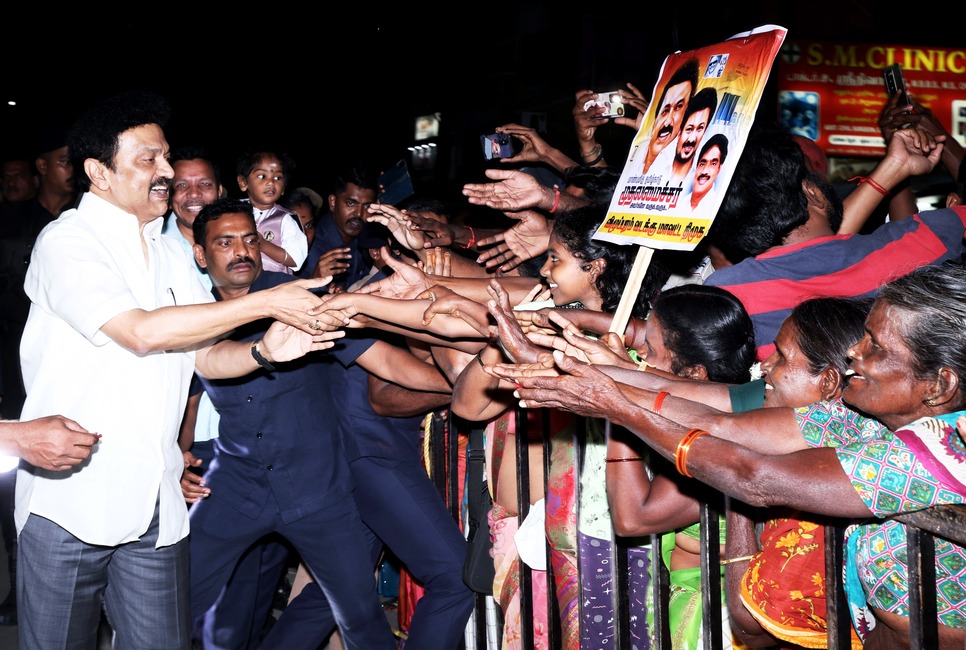
In Tamil Nadu, the choice of the people remains restricted to two parties—the DMK and AIADMK
Senior journalist and political analyst Raj Kishore says, “It is not surprising that the public was fed up with this farce. This was an era of politics when an independent MLA like Madhu Koda became the chief minister of a mineral-rich state like Jharkhand and went to jail for scams. Those with long memories will remember how unsavoury headlines dominated the front pages of newspapers. How politicians in cahoots with industrialists used to lobby to become ministers of ministries that benefited them. The Radiagate episode is just one example.”
The third force means a few seats and heavy bargaining, resulting in political instability and policy paralysis. Its ideological moorings have always been anchored in shaky ground. India is a country where, after Independence, one party dominated politics, effectively making it one-party rule. During this time countless parties emerged and disappeared.
The opposition came to power for the first time in 1977 after the Emergency but due to ideological contradictions, the government fell in just one and a half years. Then the 1989 experiment happened, which resulted in four prime ministers such as V.P. Singh, Chandra Shekhar, Deve Gowda, and Gujral assuming power in quick succession, but none of them lasted the distance.
Atal Bihari Vajpayee and Manmohan Singh also ran coalition governments. But it was difficult to escape the pressure of allies and their politics of bargaining. Perhaps it was because of this political instability that in 2014 the country formed a government with full majority after 40 years.
After two wins with an overwhelming majority each time, the BJP of Prime Minister Narendra Modi fell short of a majority for its third term, but there is no threat to the government. The same pattern is seen in all the states, which have been victims of political instability. Now either there is full majority or a close contest, but no third political party is able to find a place to become a kingmaker.
Has the idea of a third front along with the idea of a non-BJP and non-Congress political formation become meaningless? The 2024 Lok Sabha elections were different in the sense that for the first time there was no murmur of the formation of a third front. In such a situation, are we inadvertently moving towards a bipolar political system, where caste-based parties will side with either the Congress or the BJP if the opportunity arises, and the so-called secular parties will be forced to support the Congress? This is a million-dollar question. ●
(The writer is a political analyst and media strategist)
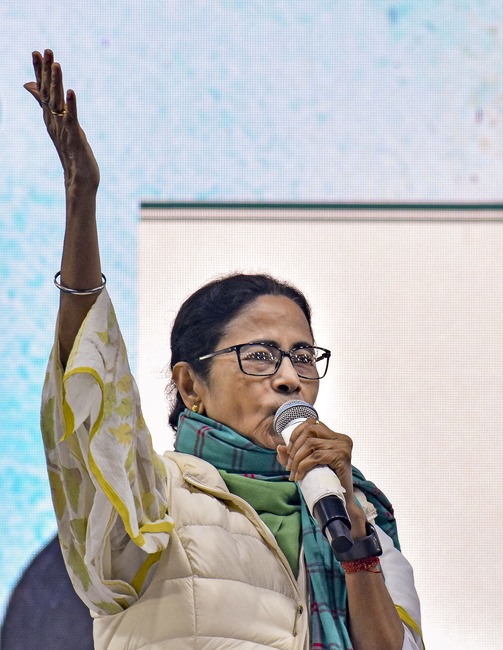
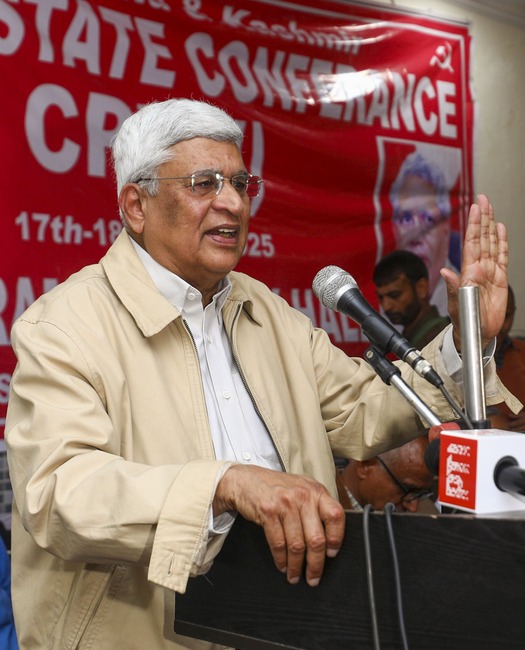
Despite the BJP’s best efforts, Mamata Banerjee’s TMC remains the most formidable political force in West Bengal, while the once
formidable Left Front has simply faded away
Add Comment