
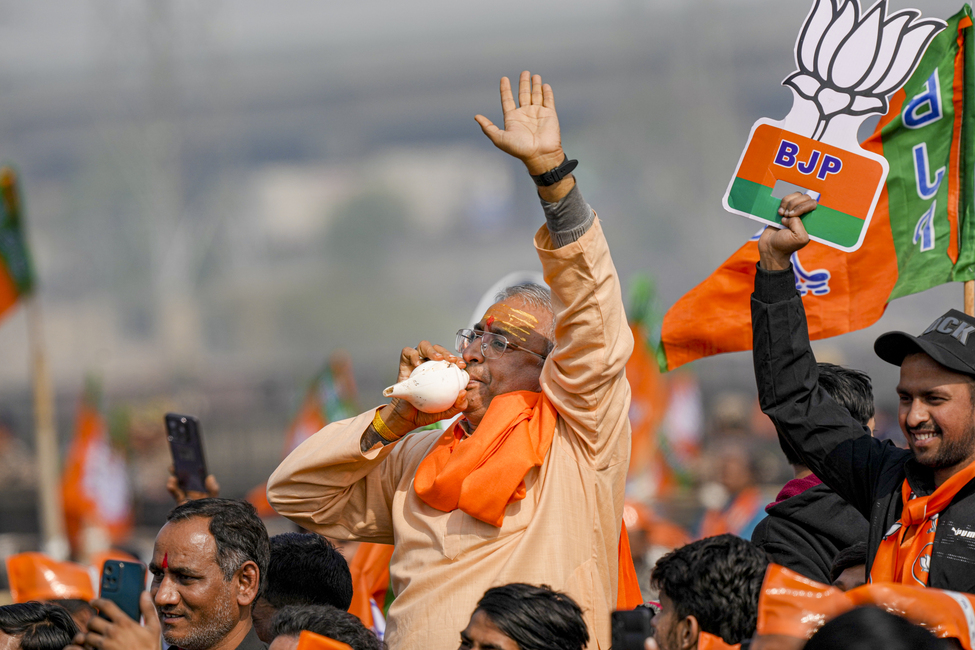
The West Bengal Assembly elections might be a year away, but the BJP and its ideological parent, the RSS, have already hit the ground running in a bid to wrest the lone remaining state in eastern India
For the Bharatiya Janata Party (BJP), which is in power in the entire northern India swathe, barring Himachal Pradesh, Punjab, and Jammu and Kashmir, and its ideological mothership, the Rashtriya Swayamsevak Sangh (RSS), West Bengal represents the last frontier in their conquest of the eastern part of the country. With the party already in power in Odisha, Assam, Manipur, and Arunachal Pradesh, and a coalition partner in the government in Bihar and Nagaland, West Bengal remains an outlier in the region.
Since the BJP’s ascendancy to power at the Centre in 2014, the Modi-Shah-centric party and the RSS have invested considerable resources in West Bengal. For the RSS, the state represents the earliest cradle of Hindu nationalism, much before Vinayak Damodar Savarkar coined the term Hindutva. More than two decades before the founding of the RSS in 1925, the Anushilan Samiti represented many of the ideas of muscular Hindu and Bengali nationalism that shaped several of its violent acts of resistance against British rule with the Chittagong Armoury raid being the most famous of its operations.
In 1910, Balakrishna Shivram Moonje, one of the most prominent leaders of the Hindu Mahasabha, who went on to become one of the founders of the RSS, sent his protege, Keshav Baliram Hedgewar—the first Sarsanghchalak—to study medicine in Calcutta, as it was called then, and learn the methods of armed subversion from the Anushilan Samiti. These old links of the past continue to shape much of the RSS’ ideology of muscular Hinduism and, by extension, of the BJP. These ideas also serve as the propellant for the RSS and BJP to consider themselves the rightful claimants to modern-day West Bengal’s politics for reviving the pre-Independence nationalistic fervour in the state.
The continuous rise of the Mamata Banerjee-led Trinamool Congress (TMC), coinciding with the collapse of the Left Front and the fading of the Congress, created a political vacuum which helped the BJP manoeuvre itself into the position of the principal opposition party by the time the 2021 Assembly elections were held. The rise of the BJP, ably helped by the RSS, has been meteoric. Its stunning rise in West Bengal politics happened in a matter of just under a decade[cite: 10]. From zero seats in 2011 to 77 in 2021, the change in tally charts its rapid growth in West Bengal[cite: 10]. In the Lok Sabha elections, the BJP tally increased from two seats in 2014 to 18 in 2019[cite: 10]. In the 2024 elections, however, its tally came down to 12.
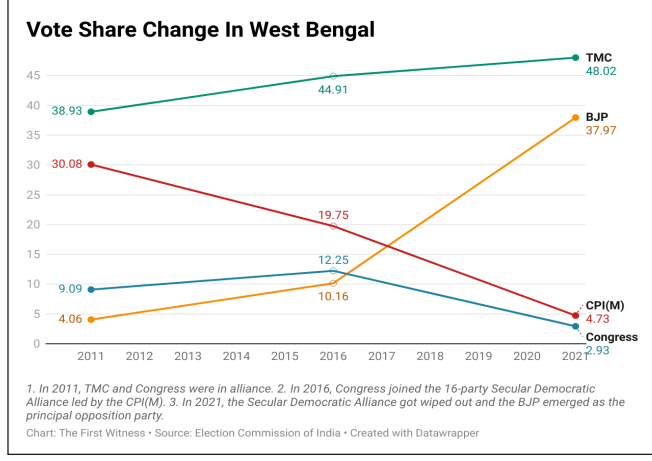
Election data reveals that the TMC not only managed to hold on to its vote share, it actually increased its share of the pie. It is the loss of vote share of the Left Front and the Congress that has directly benefitted the BJP. In 2011, the Congress fought the Assembly elections as a junior alliance partner of the TMC. In this election, the TMC secured a 38.93% vote share in 184 seats, while the Congress won 42 seats with a 9.09% vote share[cite: 10]. The Left Front managed to win 62 seats, while the BJP failed to open its account with a vote share of a mere 4.06%.
In 2016, the TMC went to the polls in alliance with the Jana Andolan Party and the Congress switched sides to join hands with the Left Front as part of the 16-party Secular Democratic Alliance (SDA). The TMC, despite fighting virtually alone, increased its vote share to 44.91%, whereas the SDA got 39.16% of the vote share. The two biggest constituents of the SDA—the CPI(M) and the Congress—got 19.75% of the votes (translating into 32 seats) and 12.25% (translating into 44 seats), respectively. The BJP, for the first time in West Bengal, touched a double-digit vote share at 10.16% for three seats.
The 2016 Assembly elections were held after a limited delimitation exercise was carried out after the historic deal for exchanging of enclaves with Bangladesh was signed in May 2015. This agreement changed the voter profiles of several constituencies that shared a border with Bangladesh. The increase of almost 6% in the BJP’s vote share in the 2016 Assembly elections laid the foundation of the party’s bigger ambitions in eastern India. With the Modi government firmly ensconced at the Centre and the BJP enjoying access to ever-increasing resources, it quickly expanded its organisational structure. Notably, the BJP won in Assam, which went to the polls along with West Bengal.
After the BJP’s resounding success in the 2019 Lok Sabha elections, when it won 18 seats in West Bengal, the path to Bidhan Sabha Bhavan seemed straightforward. Poaching as many leaders as possible from other parties was an obvious option. In 2020, the TMC, the Left parties, and the Congress saw largescale exoduses of leaders to the BJP. During this period, the TMC, in particular, lost a string of senior leaders and sitting MLAs. On December 19, 2020, 10 TMC MLAs led by Suvendu Adhikari joined the BJP. Other senior leaders like Shishir Adhikari, Mukul Roy, and Rajib Banerjee also switched allegiance.
The BJP managed to build a successful narrative that it was poised to sweep West Bengal in the 2021 Assembly elections. In the lead-up to the elections, a majority of the opinion polls predicted a marginal win for the TMC and showed the BJP making massive gains. On May 2, 2021, when the results were declared, they turned out to be only partially correct. The BJP did exceedingly well, but the TMC did even better than all the narratives and number crunching indicated.
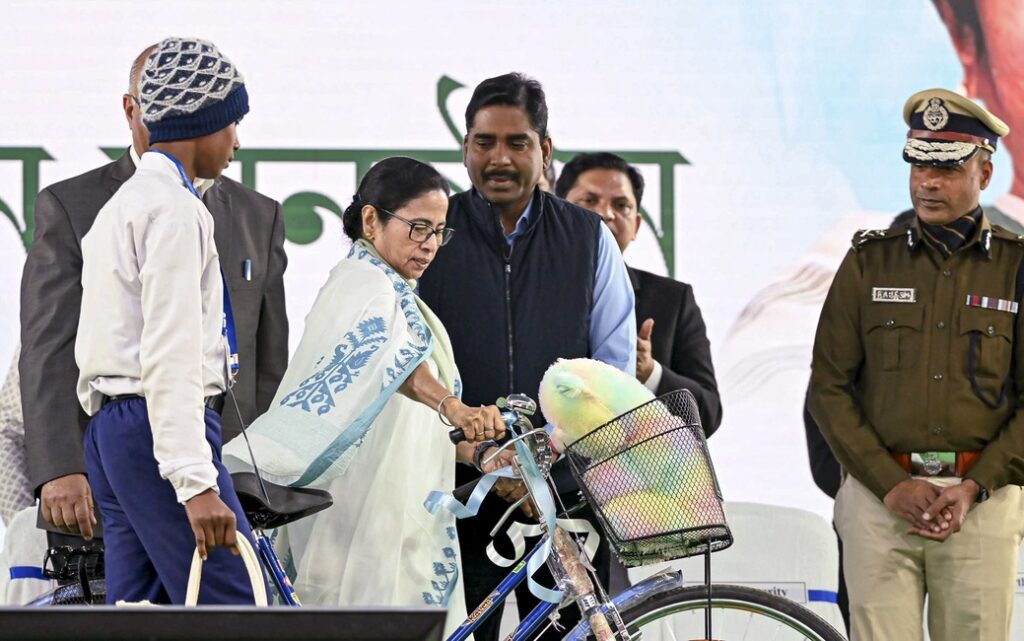
Over the years, Mamata Banerjee has managed to strengthen the social-justice plank by launching multiple schemes for various sections of society and creating a formidable vote bank
In 1910, Balakrishna Shivram Moonje, one of the most prominent leaders of the Hindu Mahasabha, who went on to become one of the founders of the RSS, sent his protege, Keshav Baliram Hedgewar—the first Sarsanghchalak—to study medicine in Calcutta, as it was called then, and learn the methods of armed subversion from the Anushilan Samiti
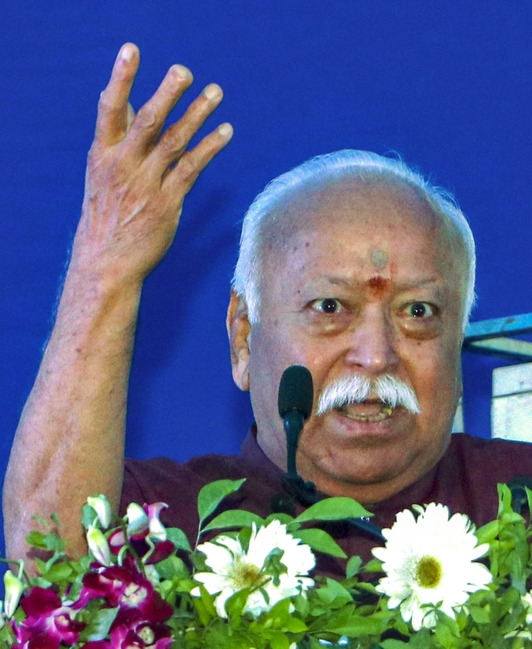
In February 2025, RSS chief Mohan Bhagwat laid out the strategy for ushering in a cultural change in West Bengal by invoking the glory of empires of ancient India
The RSS organised conclaves in Bardhaman and Kolkata for its workers over February 6-17, 2025, that were attended by the top leadership of the Sangh, including the all-powerful Sahsarkaryavahs (general secretaries). At a public rally in Bardhaman on February 16, RSS Sarshanghchalak Mohan Bhagwat exhorted the Hindu community to unite, implying that Banerjee’s 15-year rule did not serve the community’s cause
Banerjee led her party to her biggest victory since coming to power a decade earlier. The TMC won 215 seats with a vote share of 48.02%—an increase of approximately 4% since 2016—and the BJP stopped well short of the 100-seat mark with 77 seats and a vote share of 37.97%. It was easy to see from where the BJP gained its votes. The anti-Mamata votes shifted en masse towards the BJP as the Left Front and the Congress simply collapsed. The CPI(M), as the largest constituent of the Left Front, which ruled the state for 34 years, crumbled to zero seats and its vote share shrank to a minuscule 4.73%. The Congress too failed to win a single seat and its vote share fell to a mealy 2.93%. For the BJP, its win in 77 seats felt almost like coming to power.
The TMC managed to outwit the election calculus of Amit Shah by carrying out clever realignment of various social groups. Over the years Banerjee launched a number of women-centric schemes such as Kanyashree, Rupashree, Lakshmir Bhandar, and Widow Pension, to name a few, which put women voters firmly behind her. The Muslim voters from among the state’s 27% population (2011 census) consolidated in favour of the TMC, besides the Scheduled Tribes and Scheduled Castes, who have also benefited from her health, education, and food security-related schemes. The BJP’s gains came primarily from the consolidation of the non-native, non-Bengali speaking population, who back the party’s Hindutva thrust.
With Assembly elections due in 2026, the state is already witnessing intense political churn. Though there hasn’t yet been any largescale exodus of leaders from other parties to the BJP, as the principal opposition party in the state it is well placed and resourced to mount a strong challenge. The RSS too has thrown its full weight behind the BJP for the conquest of West Bengal.
The RSS organised conclaves in Bardhaman and Kolkata for its workers over February 6-17, 2025, that were attended by the top leadership of the Sangh, including the all-powerful Sahsarkaryavahs (general secretaries). At a public rally in Bardhaman on February 16, RSS Sarsanghchalak Mohan Bhagwat exhorted the Hindu community unite, implying that Banerjee’s 15 year rule did not serve the community’s cause. “People often ask why we focus only on Hindu society, and my answer is that the country’s responsible society is Hindu society. Today is not a special event. Those unaware of the Sangh often wonder what it wants. If I had to answer, I would say the Sangh seeks to organise Hindu society because it is the responsible society of the country,” said Bhagwat. RSS sources have told The First Witness that a detailed strategy for winning West Bengal was discussed at the conclave. They said that the Sangh leadership invoked the idea of conquest of Anga-Banga Kalinga in a throwback to the ancient kingdoms of the past. Anga is believed to have included the modern day regions of Bhagalpur and Munger in Bihar and the southern parts of West Bengal and Assam. Banga included the remaining parts of West Bengal and modern-day Bangladesh, while Kalinga refers to Odisha. With the BJP already in power in Assam and Odisha and being a coalition partner in Bihar, the task of capturing power in West Bengal remains the only unfinished agenda. Over the decades, the electoral map of West Bengal shows that a party which manages to capture southern Bengal rules the state. This is the reason both the BJP and RSS are devoting greatest attention to strengthening their respective organisational structure in southern Bengal.
The RSS believes that West Bengal holds the key to realising a part of the Akhand Bharat dream.
To convey the message of the need for Hindu unity, the RSS has launched an intensive campaign at the grassroots level about the plight of Hindu minorities in neighbouring Bangladesh since the fall of the Sheikh Hasina government. The expansive strategy is to propagate the RSS’ ideology at the lowest levels of society in West Bengal through community-level outreach initiatives. This is the same strategy that the RSS adopted in Haryana, Maharashtra and Delhi for putting the BJP in pole position after the setback in the 2024 Lok Sabha elections, when the party failed to cross the majority mark.
According to various reports in the vernacular press, the number of shakhas has gone up from 530 to more than 2,500 in the past 15 years of TMC rule. The RSS, and its affiliated units, now regularly stage marches through prominent thoroughfares of the main cities and towns in West Bengal. A few times, it had to approach the Calcutta High Court to take out processions after the state administration denied permission, apprehending violence.
The twin strategy that is emerging is that the RSS will be focusing on ushering in a cultural revolution for triggering political change, while the BJP will be keeping the heat up by focusing on administrative issues like corruption, communal riots like the one that took place in Murshidabad after the Waqf (Amendment) Act, 2025, was passed by Parliament, and allegedly illegal immigration from Bangladesh.
But Bengali sub nationalism, based on language, is one challenge that both the BJP and the RSS need to surmount for dislodging Banerjee. Several Bengali nationalist groups like Bangla Pakkho are working throughout the state against imposition of Hindi. To some extent, they have been successful in casting the BJP-RSS as Hindi heartland organisations, which want to impose their version of cultural hegemony based on language. The TMC too is pivoting towards Bengali sub-nationalism to counter the twin attacks by the BJP and the RSS.
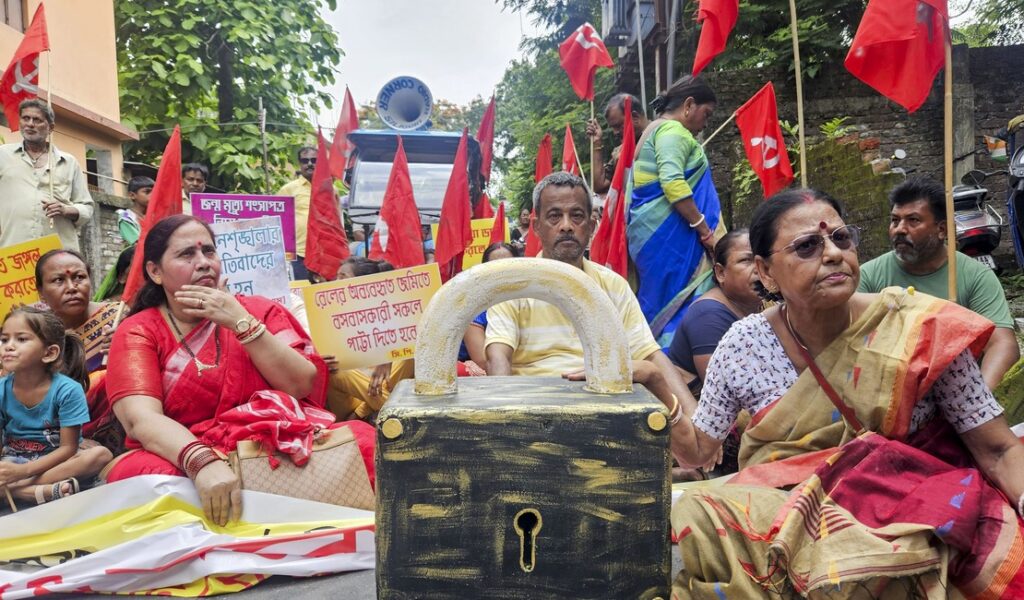
The once formidable CPI(M), which ruled West Bengal for more than three decades, has been reduced to a pale shadow of its former self. Its failure to build a younger leadership is the main reason for its decline in the state
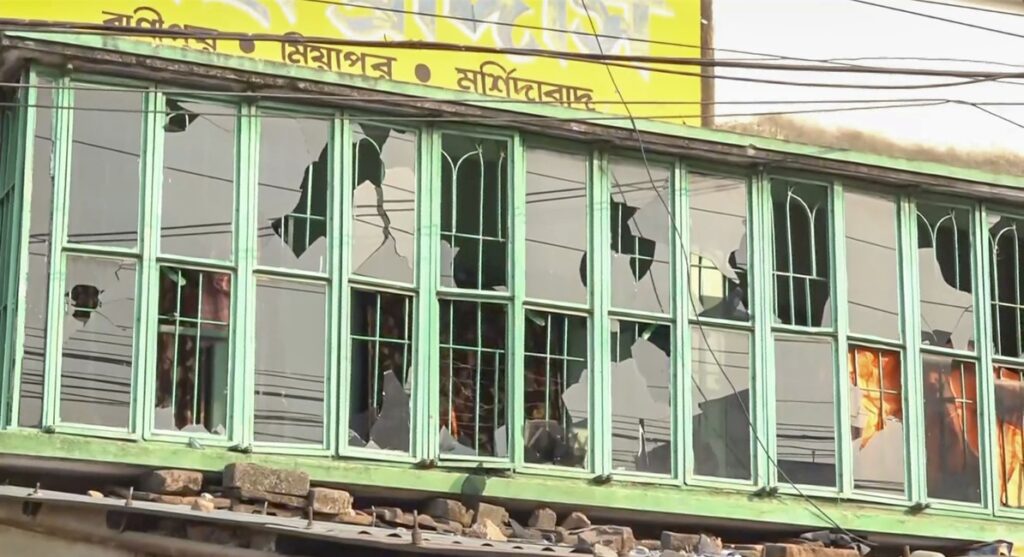
Issues like the Murshidabad violence that broke out following the protests against the Waqf (Amendment) Act, 2025, will provide the BJP with opportunities to consolidate Hindu votes in the state
Several Bengali nationalistgroups likeBangla Pakkho areworking throughout the state against imposition of Hindi. To some extent, they have been successful in casting the BJP-RSS as Hindi heartland organisations, which want to impose their version of cultural hegemony based on language