

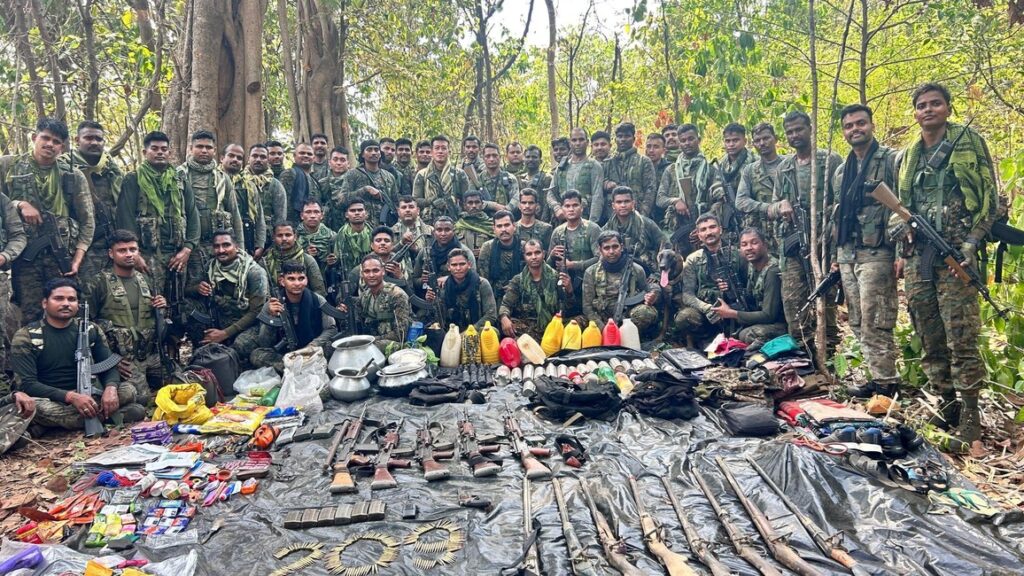
The intensified operations against Maoists by the CRPF and special units of Chhattisgarh Police have resulted in large hauls of arms and ammunitions
The recent successes against Naxalites, including the killing of senior leaders, has finally turned the tide against red terror in the heart of Chhattisgarh. Sustained security operations along with development initiatives have helped in weaning away overground support for Naxalites
On April 21, when security forces cordoned off the rugged terrain and dense forests of the Karregutta hills, straddling the inter-state border between Bijapur (Chhattisgarh) and Mulugu (Telangana) districts—the heart of Naxal territory, about 450 km from Chhattisgarh capital Raipur—it became apparent that the Naxalites would find it difficult to escape the dragnet.
As the security forces prepared for one of the biggest battles against Naxalites in the most active red corridors, the latter’s underground supporters started pleading with the government to stop the operations. More than 300 organisations and ‘concerned’ citizens wrote a letter to Prime Minister Narendra Modi, citing the unilateral ceasefire declared by the Maoists. They urged the government to halt the offensive by the security forces and start talks for a peaceful resolution.
But this time the Union Home Ministry was in no mood to step back. The Centre has deployed more than 7,000 highly-trained paramilitary commandos in the area. They first cleared the more than 450 landmines and Improvised Explosive Devices (IEDs) that blocked the access routes, shattering the illusion of the Naxalites that they were beyond the reach of the security forces. Then 500 commandos were air-dropped inside the core area with the help of a well-planned heliborne operation. In the initial phase, which lasted 24 days, there were as many as 21 encounters in which 31 Maoists were killed. Seeing their ranks ravaged, the Maoists repeatedly appealed for a ceasefire and even distributed pamphlets.
On May 21, the security forces achieved their biggest success. In a 50-hour operation, coordinated across Bastar, on the Narayanpur-Bijapur border, they killed 27 Naxalites, including the 70-year-old Nambala Keshav Rao aka Basavaraju—the head of the Maoists’ Central Military Commission (CMC) and general secretary of the CPI (Maoist).
Basavaraju headed the Maoists’ military strategy and had replaced Maoist supreme Muppala Laxman Rao alias Ganapathi in 2017. The Maoists issued a
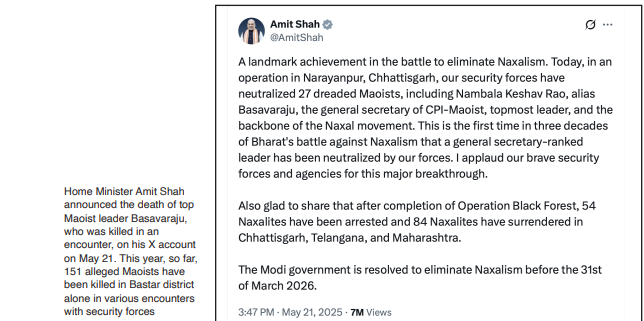
The Centre has deployed more than 7,000 highly trained paramilitary commandos in the area. They first cleared the more than 450 landmines and Improvised Explosive Devices (IEDs) that booby trapped the access routes, shattering the illusion of the Naxalites that they were beyond the reach of the security forces
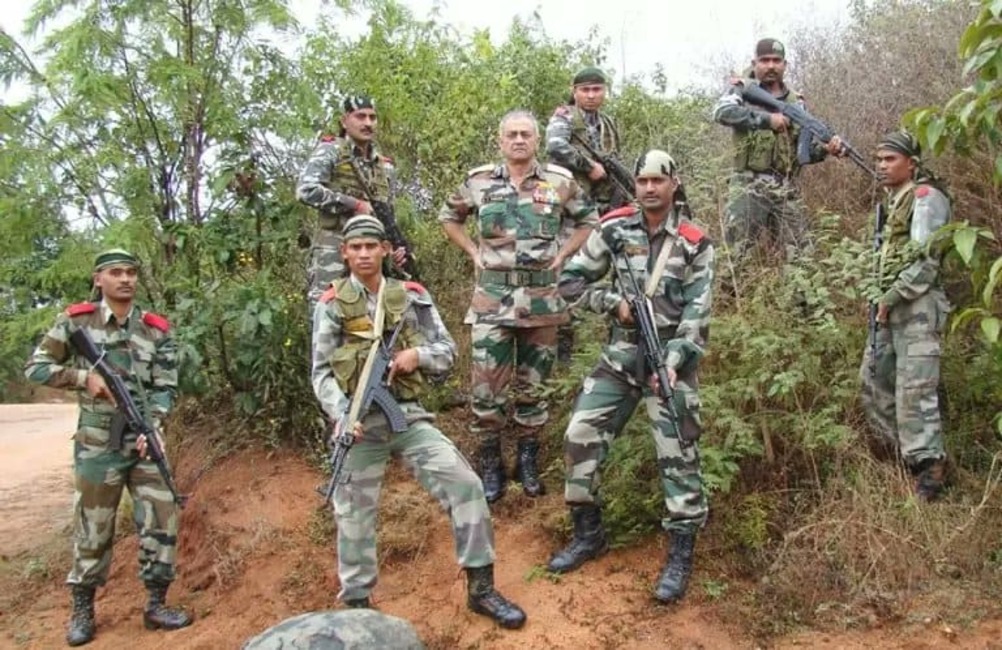
The DRG, comprising local youths and trained at the Counter Terrorism & Jungle Warfare School, Kanker, set up by Brigadier B.K.
Ponwar (Retd) (centre), has emerged as the frontline force in the fight against Maoists in Chhattisgarh
statement in November 2018 stating that Ganapati was stepping down from his responsibilities and Basavaraju was the new general secretary. Basavaraju was then the head of intelligence and military operations and was also a member of the Politburo, the Standing Committee and Central Committee. He was called the military brain of the Maoist organisation. His death has not only created a leadership crisis in the organisation; it has also broken the morale of the Naxalites. After his death, they have started surrendering in larger numbers.
“This is a historic success in the fight against Naxalism. In an operation in Narayanpur, Chhattisgarh, our security forces killed 27 dangerous Maoists, including the biggest leader of CPI (Maoist) and the backbone of the Naxal movement, Nambala Keshav Rao alias Basavaraju,” announced a triumphant Amit Shah, Union Home Minister, on May 21. “This is the first time in the three-decade fight against Naxalism that a general secretary level leader…
has been killed by the security forces. I congratulate our security forces and agencies for this big success.”After the death of Basavaraju, Naxal terror in the inaccessible forests of Chhattisgarh seems to be running out of steam. The accuracy, preparation, and coordination with which the security forces have been carrying out anti-Naxal operations for the past few months has almost crippled their network. But the most decisive role in this success has been played by the District Reserve Guard (DRG) formed by recruiting local youth. This is a special unit of the Chhattisgarh police, in which local tribal youth are recruited. These young people understand the language, geography, and social fabric of the area better, which gives them an edge in anti-Naxal operations.
According to the Narayanpur Superintendent of Police, Prabhat Kumar, “The training of these soldiers is very special. They are experts in guerrilla warfare and understanding the geography of the forest.
They can walk 25 to 35 km in any forest of Abujhmad overnight.” The DRG suffers very few losses due to the combination of training and inherent understanding of the terrain and modus operandi of the Maoists. Basavaraju himself had written in his diary: “Dear comrades, hide wherever you are…the DRG will find and kill you.” He warned his colleagues that DRG does not just search, it kills the target as soon as it finds it. This lethal force of Chhattisgarh was formed in 2015.
The commitment of the Central and state governments to end the Naxalite problem is finally yielding results that have been in the making for a long time. After taking charge of the Home Ministry, Shah had set a target of eliminating Naxalism from the country by March 31, 2026. He held many review meetings, including with the chief ministers of 10 Naxalism-affected states.
His strategy was based on a three-pronged approach of deployment, modernisation, and development of security forces. Shah gave full autonomy to the security forces and provided them with all possible support. Infrastructure development such as roads, electricity, water,schools, and hospitals in Naxalism-affected areas also weaned away support of the local population.
As part of this strategy, 612 fortified police stations and 302 new security camps were set up between 2014 and 2024 in Chhattisgarh. The fortified police stations blunted many of the Naxalite attacks on them.
Chhattisgarh Chief Minister Vishnu Dev Sai recently said that not only guns, but development is also needed. As part of the initiative, many of the security camps also served as Suvidha Kendras, where many facilities such as health care, education, and employment opportunities were provided to the local population. Under the rehabilitation policy of the state government, Naxalites who give up violence are provided financial and housing assistance, besides skill development facilities. This year, as of May 2025, more than 250 Naxalites have surrendered, including many mid-level and high-ranking Maoists. Chief Minister Sai has repeatedly emphasised that elimination of Naxalism from the state is vital for its development.
So far this year, 168 alleged Naxalites have been killed in different encounters in Chhattisgarh. Of these, 151 were killed in…Bastar division spread over seven districts, including Bijapur. During Sai’s tenure of about one and a half years, about 1,200 Naxalites have been arrested and more than 1,000 have surrendered. These include many top Maoists.
Bastar, covered with dense forests, has been a stronghold of Naxalism for decades. Poverty, unemployment, and the local population’s deprivation of government schemes made them easy prey for the Naxalites.
The Naxalites, with the help of misguided tribals, stalled the development of the region, using violence as a tool. Schools, hospitals, roads and other infrastructure became victims of Naxalite attacks. After years of sustained operations, the influence of Naxalites is now limited to only four districts of Chhattisgarh. Mainstreaming development with the help of initiatives such as the District Mineral Foundation and the Mobile Tower Project is providing the people with alternative sources of income and productive activity. As a result, Naxal recruitment has slowed, their training centres have been destroyed, and their ideology is weakening. The people of Bastar are embracing the benefits of schools, hospitals, and roads. ●
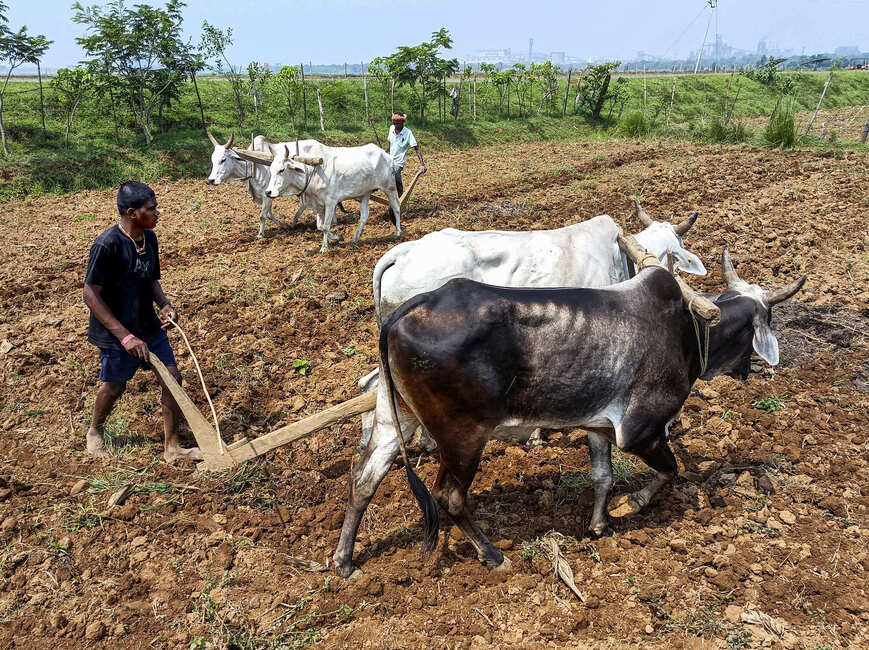
With the Maoist threat slowly diminishing, the people of Bastar are returning to their traditional professions like farming for which the state is providing support
Under the rehabilitation policy of the state government, Naxalites who give up violence are provided financial and housing assistance, besides skill development facilities. This year, as of May 2025, more than 250 Naxalites have surrendered, including many mid-level and high-ranking Maoists