
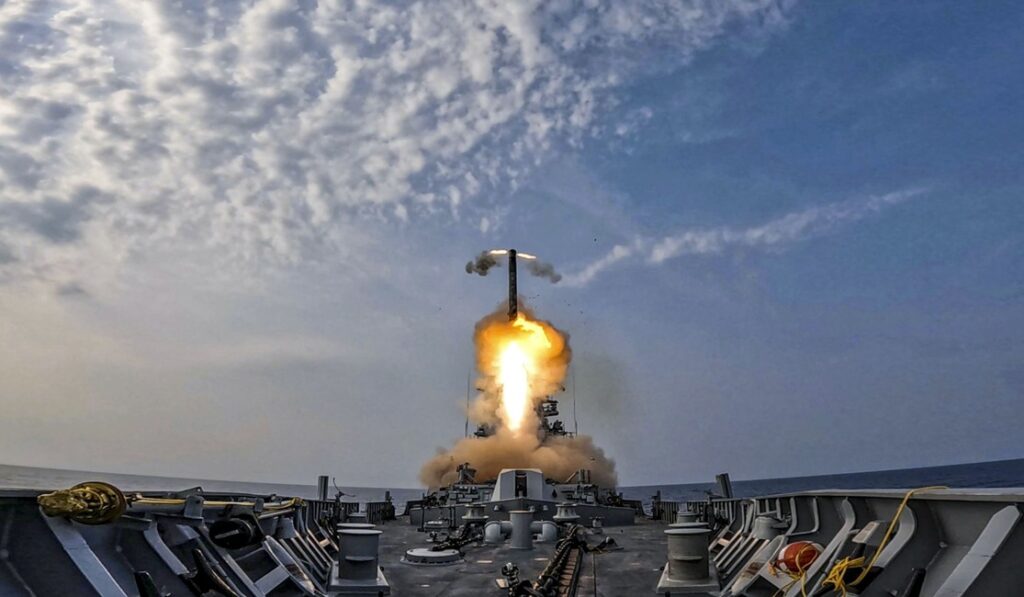
The Indian Navy practising live firing in the Arabian Sea
Many lessons need to be drawn from the latest round of India-Pakistan conflict in hindsight. But India has managed to send a clear message to the world that any further misadventure by Pakistan or China will be dealt an iron fist

By Kr. Rajiv Ranjan Singh
Editor-in-Chief
India’s response to Pakistan-sponsored terrorism as an instrument of state policy in the wake of the Pahalgam terror attack, which claimed 26 lives of mostly Hindu tourists, has yet again raised the bar for military retaliation.
The latest round of military response also marks a further departure from the strategy pursued by the Manmohan Singh-led two-term UPA government, which used to be dominated by mobilising diplomatic responses and isolated covert operations. It is now clear that Prime Minister Narendra Modi’s government won’t hesitate to inflict maximum damage on terrorist infrastructure even if it’s deep inside Pakistan. In the process, Modi has managed to call the bluff of Pakistan’s Army and its government, that have always hedged their bet on India not pursuing strategic escalation. For the first time since 1971, India’s government under Modi has shown that it’s more than willing to take the fight into the enemy’s territory and strike at the heart of Pakistan’s military assets. The contours of the break from the established patterns of responses by the previous governments to Pakistan-based terrorism can be traced to the aftermath of the attacks on the Brigade Headquarters in Uri.
On September 18, 2016, four heavily armed terrorists belonging to Jaish-e Mohammad attacked infiltrated the compound of the Brigade Headquarters and attacked the administrative quarters, killing 17 Army personnel and injuring 30 more. Though all four terrorists were killed in the ensuing gun battle, the incident jolted India’s security establishment. Ten days later, on September 28, Special Forces of the Indian Army launched debilitating strikes against terrorist bases and launch pads at multiple locations across the Line of Control (LoC). These strikes
came to be known as “surgical strikes”. The scale of the surgical strikes established a new threshold for retaliation. It signalled Modi’s approach of zero tolerance against terrorism.
In February 2019, when a suicide bomber rammed a CRPF convoy in Pulwama, killing 40 security personnel, India responded by tasking the Indian Air Force (IAF) with bombing terrorist camps in Balakot. Once again, the intent was clear:
Modi is open to using the entire spectrum of non-nuclear military options to strike against terrorist infrastructure.
Operation Sindoor, which commenced in the wee hours of May 7, delivered the most debilitating blow to Pakistan-based terrorist infrastructure till date. The IAF and the Indian Army used its most sophisticated weapon systems to strike at known terrorist bases in nine places, including the Lashkar-e-Taiba headquarters in Muridke on the outskirts of Lahore and Jaish-e-Mohammad headquarters in Bahawalpur, located more than 160 km behind the Line of Control (LoC). It has been reported thatmore than 100 terrorists and their sympathisers were killed in the May 7 attacks by Indian forces.
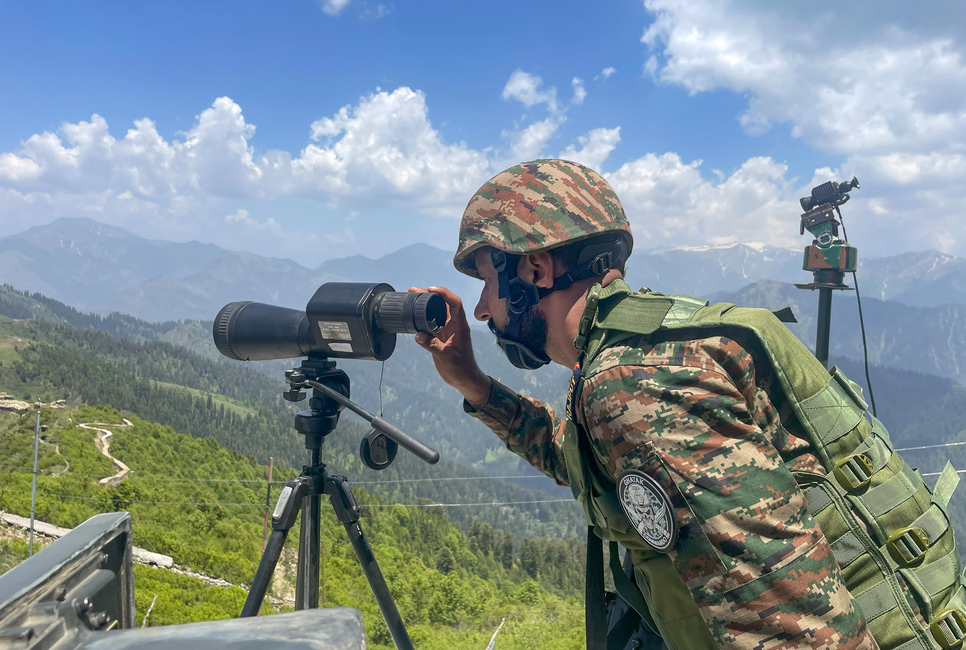
India has made it clear that it will be keeping a close watch on both China and Pakistan
Asignificant aspect of this military action was that India made it clear to the world that only terrorist bases were the target of its attacks and not the military infrastructure of Pakistan. The strategic messaging severely curtailed Pakistan’s option for retaliation, allowing India to dominate the escalation ladder. The only option left for Pakistan was to retaliate against India’s military assets and infrastructure. When a trapped Pakistan tried to hit India’s military bases and assets on May 8 and May 9, it was effectively neutered by the courageous action of our forces with the help of a multi-layered air defence system. After Pakistan tried to target India’s military infrastructure and airbases, all bets were off. India’s counterattack on close to a dozen Pakistani military sites on May 9 and 10 were not only debilitating, it also unnerved its military and civil administration. The damage that India inflicted on some of the most heavily guarded airbases and radar and air defence sites in Pakistan, including Nur Khan, which is close to the Nuclear Command centre, Sargodha, and Skardu, among others—a total of 11 sites—swung the momentum of the war decisively in India’s favour.
Now it turns out that the retaliatory attacks by India were completed in a mere 23 minutes during which it tore apart the Chinese air defence hardware and struck the targets with military precision. These strikes quickly made Pakistan realise that it stood no chance in the escalation game.
Left with no other option, Pakistan fell back on its tried and tested strategy of begging the Americans to mediate a ceasefire before more damage could be inflicted on its military assets. The swiftness and lethality with which India responded blew up all the hype surrounding the Chinese military technology which has now become Pakistan’s mainstay. The most commendable part is that India’s indigenous technologies developed over the past few years under the Make in India programme championed by Modi—such as the Akashteer command and-control system, loitering munitions, armed drones and Akash missiles proved way superior to the Chinese systems.
Another fallout of the way Chinese military hardware was annihilated on May 9 and 10 is that it will force reevaluation of their effectiveness. It also hits hard China’s ambitions to emerge as a global player in the international arms market. The sub-standard performance and destruction of Chinese frontline equipment like the HQ-9 radars—meant to track incoming missiles and drones—based in Lahore have not gone unnoticed by international experts.
There are many lessons to be drawn from the latest round of conflict between India and Pakistan. It will take time to glean the learning as more information comes out in the public domain. But the message that Modi has managed to send out to the world with the committed and professional actions of India’s armed forces is unequivocal: Pakistan’s time of using state-sponsored terror with the aim of bleeding India is up and also China has been put on notice that any further misadventure in Arunachal Pradesh and Eastern Ladakh will be dealt with an iron fist.