

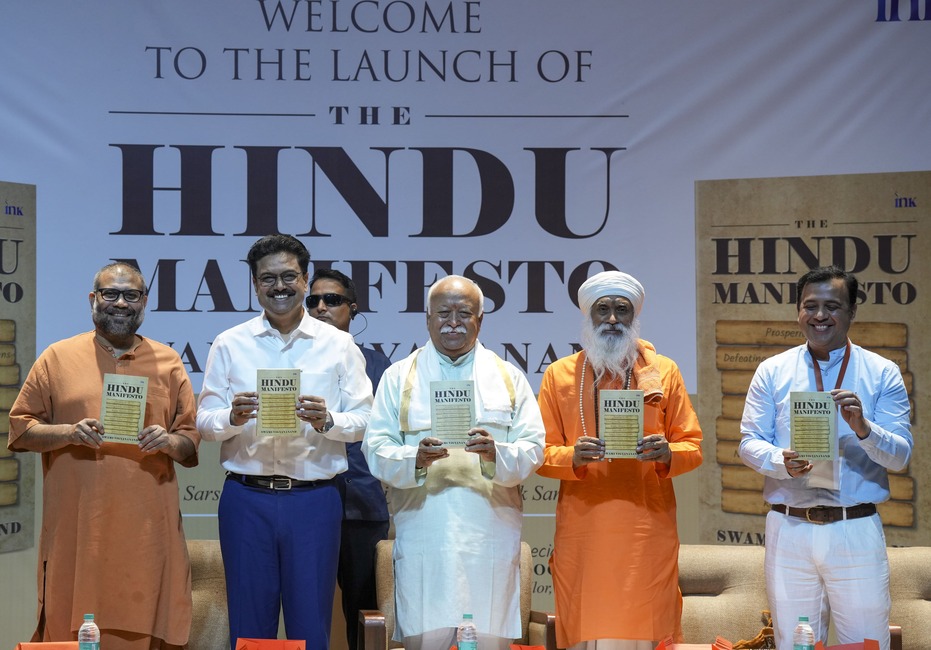
The Hindu Manifesto, authored by Swami Vigyanananda provides a clear-eyed vision for reclaiming the ancient value
systems that defined Hindu civilisation and helped it to achieve greatness for society as a whole
The civilisational knowledge of India is incomparable. India has established innumerable ideals during the Hindu rule. Our ancient religious and philosophical texts have guided kings and commoners about their duties towards serving a greater cause for building an equitable society. These tenets of civic rule have evolved with the evolution of Hindu society.
Sages have gone to great lengths to lay down rules and principles for governing every sphere of life in our ancient scriptures. However, with time and as a result of various invasions, a large section of India became ignorant of this tradition of knowledge. Many of the knowledge sources were even destroyed by the marauding Islamic invaders. This created a disconnect with the spiritual soul of India. And over time, the common people moved away from the ancient values of life that were carefully laid out by the wise sages. This in turn led to an inferiority complex and bred insecurity.
Also, the cultural onslaught unleashed by foreign forces created a chasm with Sanskrit—the language of ancient India. Attempts to revive the ancient soul of India mostly ended in disappointment due to the disconnect of the people with the civilisational wisdom and with Sanskrit.
Just as the sages propagated the tenets of devotion, knowledge, and wisdom among the common people in a language that was suitable for the times, similarly in modern times there are saints who are presenting the ancient knowledge in a language that is understood by today’s young generation.
In this respect, Swami Vigyananand’s book The Hindu Manifesto presents an outline for the reawakening of Hindu society by instilling a sense of self-pride. Swami Vigyananand has written this book after years of deep research and contemplation and living a life inspired by the teachings of Swami Vivekananda.
His penance is fully reflected in this book. He writes about the sutras of Hindus, and how they serve as the contextual framework for The Hindu Manifesto. These sutras are not just quotations from various scriptures, they are living principles—being followed by Hindu society till date. Based on the eight sutras, the eight chapters serve as a ready reckoner for becoming an ideal Hindu for the upliftment of society.
The eight chapters focus on: prosperity for all, national security, quality education, responsible democracy, respect for women, social harmony, sanctity of nature, and reverence for motherland and heritage. When we look at the guiding principles, they are: Dharmasya Moolam Artha, Shatrun Jai Praja Raksha, Nasti Vidyasam Chakshu, Avishramoyam Loktantraadhikaar, Agra Eti Yuvatirrahrayana, Ekavarnastada Lauko, Sarva Shanti, and Mata Bhumi.
The book also highlights the interlinkages of these eight principles that define Hindu society. For example, the interrelationship between religion and wealth or how knowledge is directly linked to the welfare of the people. Regarding religion, Swami Vigyananand writes that the biggest contribution of Hindus to humanity is religion.
The book also provides a blueprint on the sutras for the destruction of the enemy for the security of the state and society. It says it is the basic duty of the state to destroy its enemies for the protection of its citizens.
While elaborating about being a responsible democracy, Swami Vigyananand writes about how the Vedic kings were chosen and the selection process, detailing the qualifications and eligibility of ministers.
In the section about love for the motherland, the book delves into considerable details. It makes readers understand the damages caused by a colonial education system, including how it erased a rich and traditional knowledge system.
The fifth chapter provides guidelines for overcoming the inferiority complex that was drilled into the minds of Hindus for centuries regarding the role and treatment of Hindu women in society. The sages composed many hymns in the Rig Veda dedicated to countless women such as Romasha, Lopaymudra, and Vishwavara, who worked towards enriching the value-based knowledge systems of Hindus. This book should be read not only by Hindus, but by anyone who believes in human values.
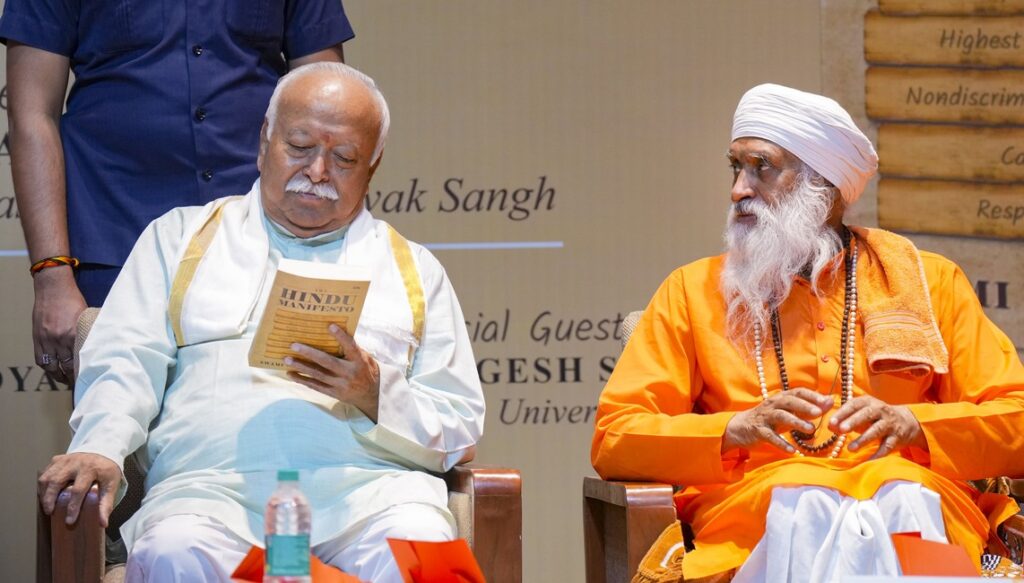
Rashtriya Swayamsevak Sangh chief Mohan Bhagwat with Krishna Shah Vidyarthi Maharaj of Valmiki Mandir
at the launch of the book last month in New Delhi