

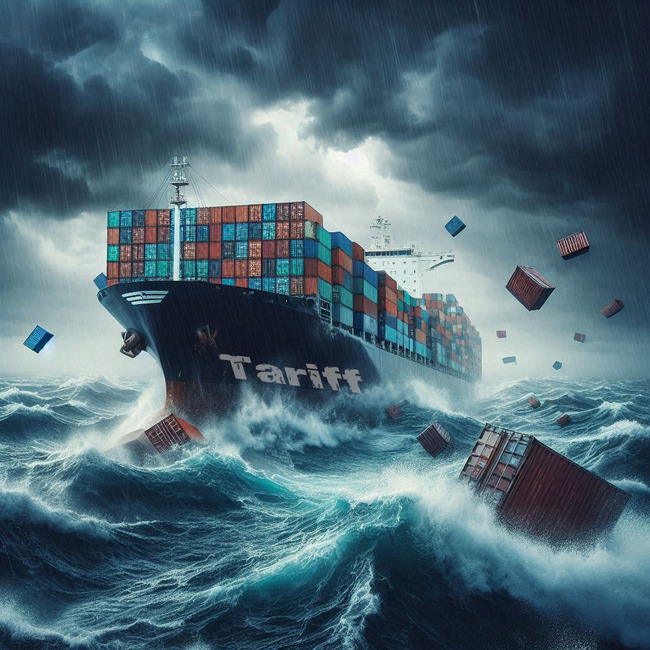
With Donald Trump doubling down on imposing reciprocal tariffs in the hope of balancing trade, India needs to develop a coherent strategy to not only shield its key domestic sectors but also to protect its export earnings from the US market
Donald Trump’s return to the White House as the 47th President of the US, despite criminal charges and convictions, has lent him an impetus which was lagging in his first term. His protectionist trade policies, which took three to four years to take effect in his previous term, have seen roller-coaster implementation in less than three months since his return to the Oval Office. His administration’s aggressive tariff strategy—marked by a baseline 10% duty on imports from most nations, 26% for India, a temporary 90- day pause on reciprocal tariffs (announced April 9, 2025) and escalated duties on Chinese goods up to 145 —signals a profound shift in global trade dynamics. This mercantilist approach, rooted in addressing US trade deficits and funding proposed tax cuts, poses both challenges and opportunities for India, which had a $45.7 billion trade surplus with the US in 2023-24. If the two countries are unable to reach a trade agreement, then India’s agriculture, automotive, pharmaceutical, petroleum and services sectors will feel the impact of the heightened US tariff regime.
Trump’s trade policy, influenced by advisers like Peter Navarro, reflects a long-held belief that trade surpluses equate to economic victory—a view articulated as early as 1987 when he criticised Japan’s trade practices. While the power establishment in Washington, DC, might view the imposition of tariffs as the single most important factor for equalising trade—a highly contentious position in global trade—Wall Street and the US bond market viewed it negatively. The sharp rise in the bond yield rates after Trump announced reciprocal tariffs forced a rethink in his inner circle of policy advisers. The potential damage to the US financial system due to escalating yield and its adverse impact on interest rates was not lost on the tariff warriors. It compelled a major Trump climbdown in less than 24 hours—after imposing tariffs on allies and enemies alike—to announce a 90-day moratorium on reciprocal tariffs. During this period the US government said that it will negotiate trade deals with individual countries.
On April 11, 2025, US Treasury Secretary Scott Bessent highlighted India’s willingness to “sit at the table”. Following the 90-day moratorium, the 26% reciprocal tariff on Indian imports might have been paused, but the 10% universal import duty remains in place. The exclusion of China from the pause, coupled with a 145% tariff hike, underscores a targeted escalation against Beijing, potentially reshaping global supply chains. On April 12, China responded by slapping a 125% import duty—up from 84% announced earlier—on US goods besides restricting the supply of rare earth minerals, magnets, and semiconductors to the US. These restrictions bear a direct impact on the US’ technology, aerospace, and defence sectors.
According to the International Monetary Fund (IMF), a universal 10% rise in US tariffs, accompanied by retaliation from the European Union and China, could shrink US GDP by 1% and global GDP by roughly 0.5% through 2026. For India, this volatility offers a window to negotiate exemptions, but the risk of retaliatory disruptions remains high.
Agriculture: Balancing Export Vulnerability And Diversification
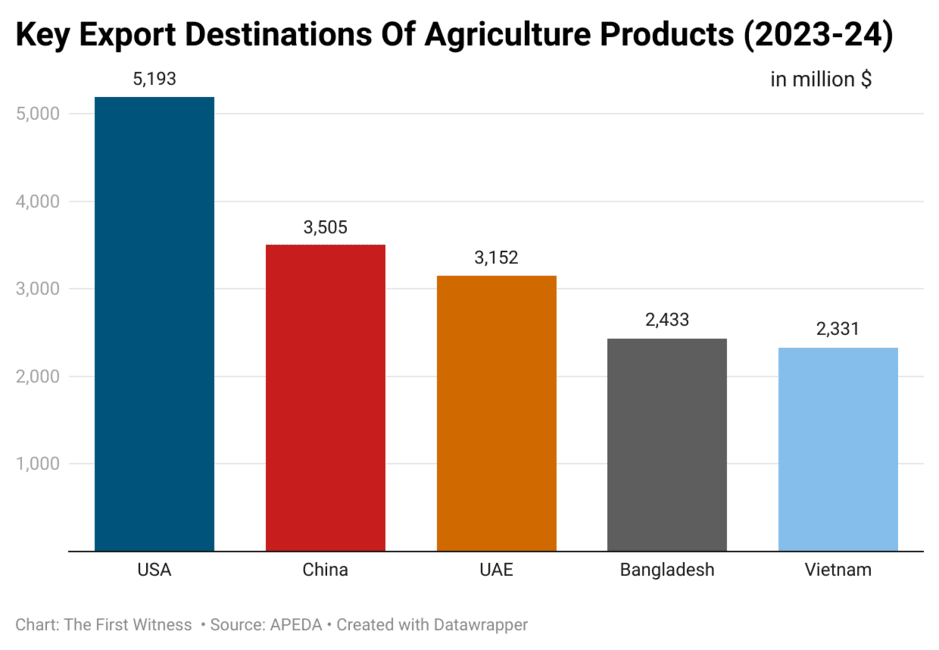
According to the 2024 Economic Survey, India’s agricultural sector, which contributes 18.2% to the national GDP and employs 42.3% of its workforce, is a $400 billion industry with $53 billion in exports in 2022-23. Key commodities like basmati rice ($5.8 billion), cotton ($6.2 billion) and spices ($3.8 billion) target the US—a market accounting for 8% of agricultural exports.
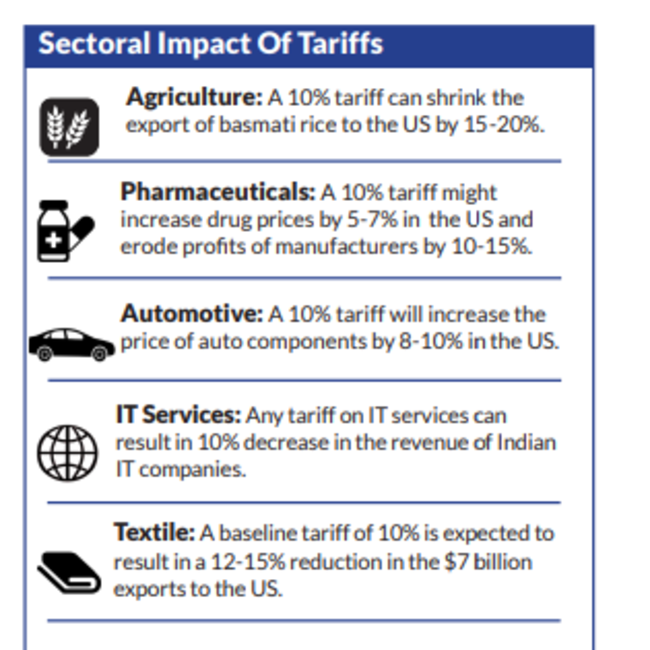
rump’s tariff threats could trigger a substantial reduction of India’s farm exports and depress agricultural income significantly. For instance, according to the Agricultural and Processed Food Products Export Development Authority (APEDA), a 10% tariff could shrink basmati exports by 15-20%, pushing the price down even further in the domestic market which is already suffering from oversupply.
Yet, this disruption could catalyse diversification. Africa, with a $10 billion import gap and Southeast Asia, growing at 5% annually, offer untapped markets.
The challenge lies in infrastructure—rural connectivity lags at 60 (NITI Aayog, 2024)—and logistical costs, which could rise 10- 15% without government support.
The Ministry of Agriculture’s response, including the Rs 1 lakh crore Agricultural Infrastructure Fund, must accelerate to pivot supply chains.

Automotive Sector: Supply Chain Realignment
The Indian automotive industry, contributing 7.1% to GDP and employing 37 million people, exported $18.2 billion in components and vehicles in 2023-24. The sector also makes up 4.7% of India’s total exports and represents 40% of global R&D activities. The US, absorbing $5 billion in two wheelers and parts, faces risks of 25% duties on steel and aluminium products. A 10% hike could raise component costs by 8-12%, prompting US firms to explore Mexico or Vietnam, according to industry forecasts. This threatens 15% of export revenue for companies like Tata Motors and Bajaj Auto.
However, the Make in India initiative could gain traction, with $2 billion in planned investments by 2027. Enhanced local assembly and R&D in electric vehicles (EVs), supported by the Rs 18,000 crore FAME-II scheme, could offset losses.
Pharmaceuticals: The Generics Powerhouse Under Pressure
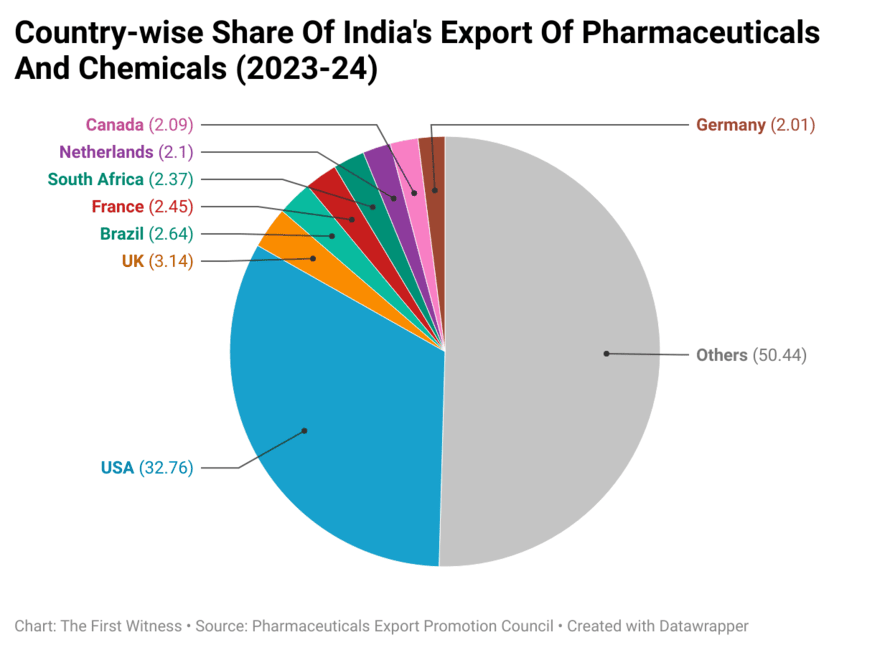
India’s pharmaceutical sector, dubbed the “pharmacy of the world,” holds a 20% share of global generics by volume, with exports reaching $27.85 billion in 2023-24, including $9.7 billion to the US. According to a report by healthcare data management company IQVIA, Indian pharmaceutical companies helped save the US $219 billion in 2022 and contributed a total of $1.3 trillion in savings from 2013 to 2022. Indian companies supplied 47% of all generic prescriptions filed in the US and 15% of the volume of biosimilars (generics). Trump’s reciprocal tariff will have a huge impact on Indian pharmaceutical companies like Dr Reddy’s (47% of revenue) and Granules India (65% of revenue), which have established significant presence in the US market. According to Nuvama Institutional Equities, a 10% tariff could erode 10-15% of their profit margins, forcing cost passthroughs that would inflate the drug prices by 5-7%. The industry’s response could include lobbying for a mutual duty waiver, leveraging India’s indispensability as one of the largest suppliers of pharmaceuticals to the US as alternative sources like Israel or Germany lack the scale to replace India’s $9.7 billion supply.
High-margin players like Sun Pharma (32% of revenue from the US and profit margins of 30-35% ) might be able to absorb shocks, but smaller firms might shift to markets like Brazil or South Africa. Production relocation to the US, though feasible in two to three years, would negate India’s 30-40% cost advantage, say industry sources.
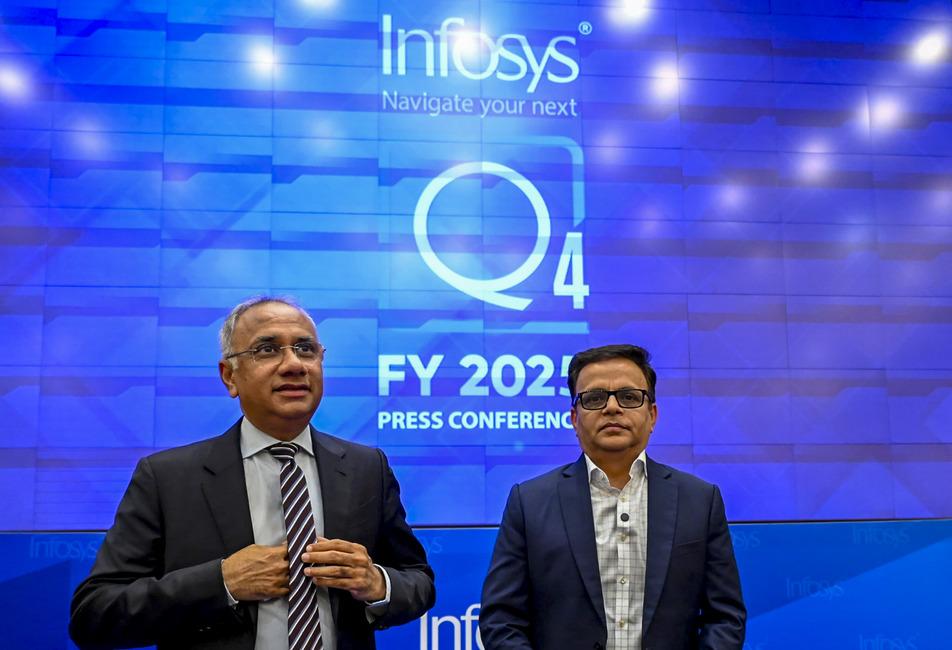
Infosys CEO Salil Parekh and CFO Jayesh Sanghrajka at the press conference during the announcement of Q4 results of the company in Bengaluru on April 17, 2025
Services: Navigating Demand
India’s services sector, contributing 54% to GDP and exporting $194 billion in IT and BPO in 2023-24, faces mixed impacts. The US accounts for 60-70% of IT revenue for firms like Infosys and TCS, which remains stable under the tariff pause. However, a stronger dollar—up 5% since April 2025 due to tariff volatility—could boost outsourcing contracts by 3 5%, according to industry estimates. Yet, geopolitical tensions might push US clients toward nearshoring, risking a 10% revenue dip. Indian IT companies are already facing global headwinds. The Q4 results for FY 2024-25 already signal a downturn in the profits of Infosys and TCS. TCS reported a 1.7% decline in profit after tax (PAT) for Q4, while Infosys reported an 11.75% Q4 decline in consolidated profits on a yearon-year basis. Only Wipro reported a 26% increase in consolidated profits, but indicated that currency fluctuation will result in 1.5-3.5% decline in revenues in Q1 of FY 2025-26. Other IT companies have also issued similar guidance. The 90-day pause offers a chance to deepen ties with the EU and Japan, where demand grows at 6% annually.
Other Key Industries: Textiles, Manufacturing And Energy
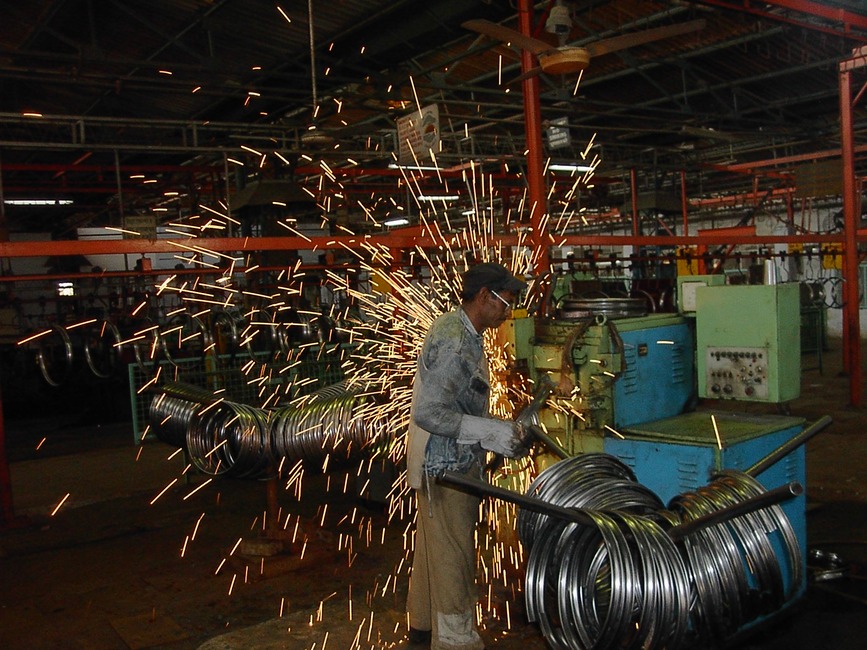
Out of India’s textile exports of $40 billion in 2023-24 the US contributes $7 billion. A 10% tariff could cut this by 12-15%, according to the Textile Ministry, pushing firms toward Europe ($8 billion market) and Africa. Manufacturing, with $100 billion in exports, could attract $5 billion in redirected investments if India becomes a China-plus one hub, though infrastructure gaps (for example, 40% port congestion) pose hurdles. The energy sector, exporting $10 billion in renewables, faces risks if US tariffs on Chinese panels spill over. However, if the increased tariff on Chinese solar panels, EVs etc., continues, it could propel the Indian green tech industry by providing it a large chunk of the market.
Macroeconomic Implications
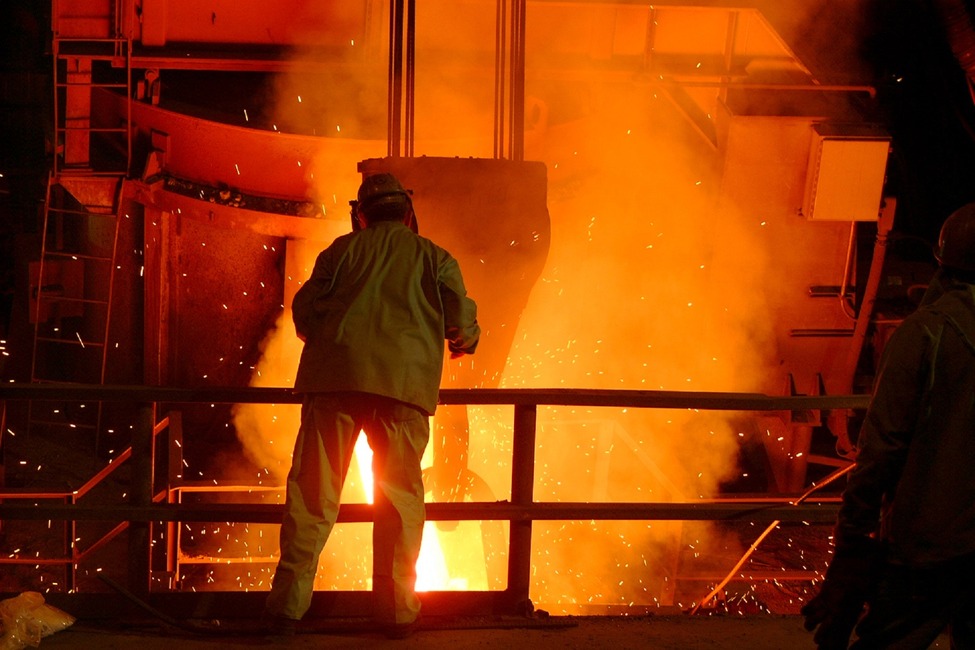
The US Federal Reserve anticipates that tariff-driven inflation, aiming to fund a $2 trillion tax cut, could rise to between 3.5% and 4%, while projecting GDP growth dropping below 1%, curbing demand and slowing global growth to 2.8% in 2025. For India, a 0.8-0.9% GDP growth hit is projected, with inflation rising 0.5-1% due to import costs. Indian exports to the US may reduce by $30-33 billion.
The rupee, already volatile, may depreciate 3-5% against the dollar, say forex analysts. India’s strategic response includes the launch of the Global Tariff and Trade Helpdesk on April 11, 2025, to address export challenges. Diplomatic efforts, evidenced by Trump’s inclusion of India in the pause, could yield a bilateral deal, building on the $45 billion trade surplus. Domestically, resource allocation in R&D incentives for generics and green tech, alongside infrastructure upgrades, are critical. The pause offers a 90-day window to negotiate exemptions, leveraging India’s $219 billion US healthcare savings.
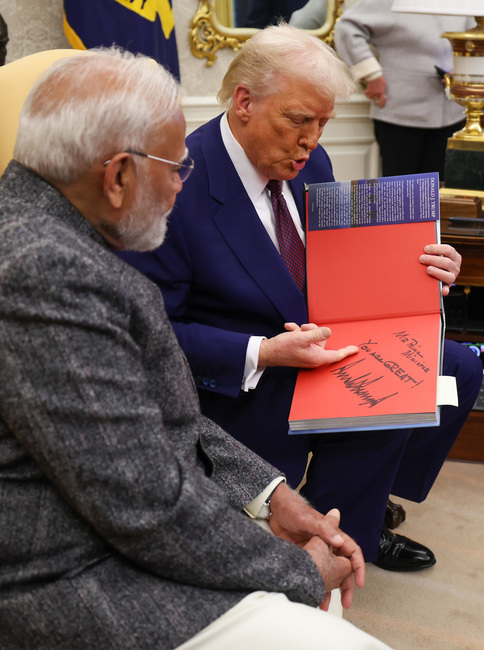
The fate of future negotiations on tariffs between India and US will most likely be determined to a great extent by the personal equation between PM Narendra Modi and President Donald Trump
The Reserve Bank of India has revised its FY26 GDP growth projection to 6.5%, down from the earlier estimate of 6.7%. To cushion the economy from external shocks and bolster domestic growth in a shifting global trade landscape, the RBI has adopted an accommodative stance, reduced the repo rate by 25 basis points to 6%, and maintained its liquidity support measures. Trump’s flip-flop on tariffs and the lack of a coherent policy approach in the White House will test India’s economic resilience across agriculture, pharmaceuticals, automotive, services and beyond. While export sectors face immediate risks, the pause and global realignment offer opportunities for diversification and self reliance. India has not only to move swiftly and with clarity to protect foreign trade, it will also need to prepare a host of countermeasures in case of failure to reach a trade agreement with the Trump administration.
https://shorturl.fm/UahB7
https://shorturl.fm/KprUT
https://shorturl.fm/9hl3O
https://shorturl.fm/c5jzx
https://shorturl.fm/tW3km
https://shorturl.fm/4o5HL
https://shorturl.fm/6qULe
https://shorturl.fm/NEtsz
https://shorturl.fm/sivXi
https://shorturl.fm/dyShF
https://shorturl.fm/8mgS6
https://shorturl.fm/dB6v9
https://shorturl.fm/AxWAq
https://shorturl.fm/faNXB